
Introduction
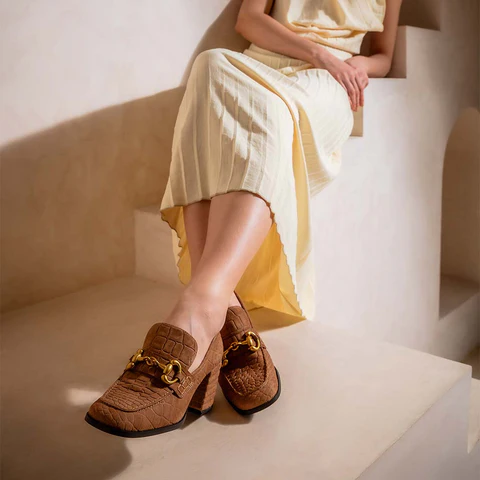
Genuine leather is the most ”alive” material in the world of shoes, because it molds itself to your foot and adapts to your gait — and that's the main reason leather shoes are more comfortable than synthetic ones.
But… how does genuine leather turn from a flat piece into a comfortable shoe that fits the shape of a woman's foot?
The secret lies inthe process of shaping the leather over the foot last, considered the most important stage in handmade shoemaking.
First: Choosing the right leather thickness
Genuine leather comes in different degrees of thickness and flexibility.
The best types for shaping:
- Soft leather (Nappa)
- Full-grain leather (Full Grain)
- Natural suede
Leather suitable for shaping must be:
✔️ Flexible
✔️ Stretchable
✔️ Resistant to pressure
✔️ Doesn't crack
If the leather is stiff or of poor quality, it won't shape properly to the foot.
Second: Heating and preparing the leather
Before the shaping process, the leather is “prepared”.
The preparation includes:
- Dampening the leather
- Lightly heating it
- Making it more flexible
When genuine leather warms up, it becomes thinner and responds easily to stretching, which helps it capture the shape of the foot with high precision.
Third: Stretching the leather over the foot last (Last)
And this is the most important stage of all…
The last is a three-dimensional model of the real shape of the foot.
At this stage:
- The leather is stretched with calculated force
- It's fixed in place with special pins
- The toe and sides are adjusted
- The surface is smoothed out without folds
The genuine leather begins to settle onto the last and take on the real shape of the foot.
Fourth: Letting the leather set
After stretching, the leather is left for hours (and sometimes days) until it ”holds” the shape.
During this time:
- The leather dries gradually
- It retains the imprint of the last
- It sets without reverting to its flat shape
And this is one of the secrets of comfort in handmade shoes:
The leather remembers the shape of the foot.
Fifth: Stitching the leather after shaping
After the leather sets on the last, the craftsman begins stitching the pieces together.
Why stitch after shaping?
Because:
- The leather is already in the shape of the foot
- The measurements have become precise
- The shoe will stay stable and fit the foot
Hand-stitching here reinforces the leather's stability in its new shape.
Sixth: Attaching the sole and fixing the final shape
After stitching:
- The sole is added, made of leather or rubber
- It's fixed in place with special materials plus stitching
- The heel is shaped
- The edges are adjusted
Now the shape of the foot is set within the leather.
Seventh: Why leather shoes are comfortable from the very first wear
Because genuine leather:
- Shapes to the foot
- Expands in a healthy way
- Breathable
- Prevents friction
- Distributes weight evenly
After a few days of wear, the shoe becomes ”tailor-made just for you.”
Eighth: Why doesn't this happen with synthetic leather?
Synthetic leather:
- Doesn't stretch
- Doesn't breathe
- Doesn't mold
- Resists change
- Cracks under pressure
That's why synthetic shoes cause pain… because they're too stiff and don't adapt to the foot.
In Summary
The process of shaping genuine leather over the foot last is the secret to comfort in handmade shoes.
And the essence of the secret:
✔️ Flexible genuine leather
✔️ Preparation and heating
✔️ Precise stretching over the last
✔️ Setting for hours
✔️ Stitching after shaping
✔️ A stable, comfortable sole
And that's how leather turns from a flat piece… into a comfortable shoe that lasts for years.





Leave a comment